
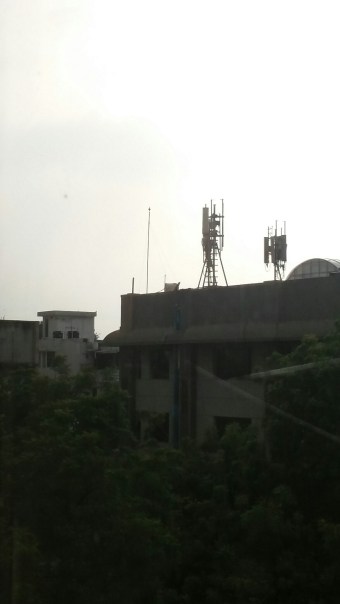
In my first entry I will focus on the season, it is monsoon season. For the Indian subcontinent, this time of the year is enormously important. But it can also bring disastrous catastrophes over the country. More about that at a later point, another day.
The importance of the season is also reflected in the name of the term at the university. Whereas in the U.S. the semester that starts in August is called Fall Term (and Winter Term in Germany), in India, it is called Monsoon Term. During the monsoon season it is possible that semi-deserts turn into lush green grass land where all sorts of plants and crops can flourish. That makes it obvious how important the season is for the Indian people. The monsoon rain guarantees the harvest for a whole year. But that means that if the rain does not come or does not bring enough water or even way too much rain so that the fields get flooded, as a result there will be a poor crop and many, many people will be starving. Hunger is the consequence.
Before we came to Delhi, I tried to prepare myself mentally for what live will like to be during the monsoon season. At least that was what I thought. I saw myself through my inner eye, always rushing with my umbrella above me that protects my head from the heavily pouring rain. I tried to adjust to the idea of having to deal with permanently wet clothes that stick to my body. But soon I noticed: I had a completely wrong idea. I assumed that it would be raining every day—not just some drops, no! I expected it to rain cats and dogs daily. However, that is not the case, at least not in Delhi or Haryana, a state in the north of Delhi. So far, we have not witnessed many rainy days. When it is raining then it is a heavy rain but it is not at all what I expected a monsoon rain would be like.
Here, the monsoon season involves a lot of cloud-covered skies and it is grey or at least greyish. I think, it took ten days before I saw the first blue sky over India. Such a blue that you can actually call blue sky. That was kind of a depressing or more a strange experience. If it is hot in Germany or the part of the U.S. I know best, the sun is shining until it is getting really hot. As a result of the heat, clouds get formed and then one can already feel a thunderstorm coming. Here things are very different. It is grey, overcast and extremely warm, day by day by day, with no rain or thunderstorm in sight. Anyhow, clothes are sticking to the body, just not because of the rain.
But if there is a thunderstorm then it is really stormy. Just a couple of days ago it was like that. In the middle of the night we all woke up due to bright lightning and extremely loud thunder. The grumble of the thunder was to be heard for a long time. Actually, it was grumbling until the next lightning was to be seen followed by another loud bang. The rain was not as frightening as the sounds. They were monstrous.
When there was a terribly loud thunder my daughter freaked out. She screamed. After she had caught her breath, she asked, desperately: “Do they have lightning protection in India?”
Oh, good question, I thought …but just for a little second, then I was back to being the comforting Mom I had to be and said: “Of course, there are lightning protections here. You do not have to be afraid!” In my mind, thoughts were rushing, because so far, I have not seen any lightning protection. I have to admit that lightning protections are not the first things I pay attention to, especially in a country like India.
First thing in the morning, I checked on Google whether there is lightning protection in this country. I was relieved. During the following cab ride my eyes were searching for the protection devices. I was not able to spot many, but at one point I noticed that it is the same as with many other things in India. The nicer, well-built houses had some kind of a construction that, I think, could be a lightning protection. But on top of more modest houses, or on the huts, not to mention the tents in the slums, I haven’t seen any kind of protection whatsoever. As it seems, there is none. The topic of this two-class society (I think there are even more classes) is one that I will discuss more often here. It is something that stands out to me everywhere, at any corner, always.
But for today I conclude this post with my warmest “Namaste”!
 Adventures in India - Sabrinas Indienblog