
I return to writing here after a long time during which I was challenged quite a bit job-wise. I hope that from now on, I will find more time again to write regularly. After all, there is so much to write about! The biggest topic right now is, of course, the Corona virus. I will write about that topic later for sure, but sometimes it is not the big topics, but the little stories that are worth talking about. This is something that struck me just a couple of days ago when I was talking to my friends. Today, I will therefore write about a very ordinary topic: electricity!
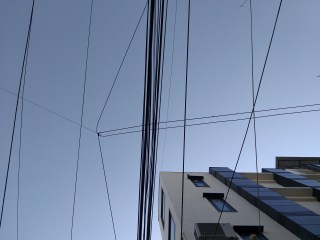
In Germany, one plugs in the plug and electric devices start to function. Most of the time at least! Blackouts are rather rare and are more or less akin to a tragedy in Germany, well organized and well-regulated such as it is. I remember very few such events from my childhood: when a power cut for maintenance work had been announced, BIG preparations were made. Just in case!
When we lived in the U.S., we noticed that there, the relationship towards electricity was in many ways different. Most strikingly, one could see all the power lines. They were not underground, as they are even in my tiny little home town village (home to just a couple hundred souls), and even back when I was a kid. 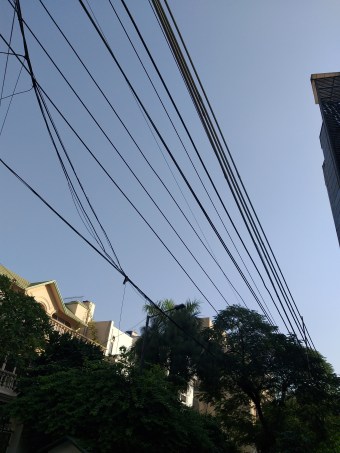 Quite to the contrary, the power lines were hanging above our heads in a wild mesh, reminiscent of a spider’s web. Suddenly certain earlier bits of information that I had seen on the news made much more sense. I had always been slightly confused whenever I heard that after a hurricane in the U.S. even big cities were without electricity for days, sometimes even for weeks. Seeing the power lines above the ground made me realize why: surely, one big tree collapsing on a power line had to cut many households off electricity, perhaps entire neighborhoods. And of course, hurricanes typically uproot not just one tree, but many! As it turned out, this experience from the land of unlimited possibilities was a good preparation for India.
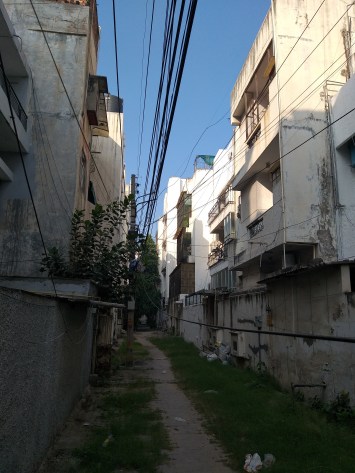
Here, too, power lines criss-cross wildly above our heads. One reason is certainly that Indians seem to have a much more practical and hands-on approach. Your house needs electricity? No problem. Establish a connection with the main power line up there by connecting it to the household that needs electricity. One might wonder whether anyone knows how many such connections fork off from the main line. On the other hand, I am also pretty sure that there are volumes of note books in which every such fork is meticulously noted and written down. (The topic of the Indian penchant for filling note books and protocols deserves its own post at some later point.)
Back to the topic of electricity. The way how one acquires electricity is as interesting as the way power connections get severed. The latter was something I was able to observe last weekend. We had a blackout once again. It is not really a fun event when the thermometer shows 43° C (109.4° F) and suddenly the AC stops working and the fans are no longer running. Immediately beads of sweat begin to run down one’s back. No fun indeed!
This kind of blackout happened for the third time in a row, in short succession, last weekend, which is quite unusual in our neighborhood. In general, we don’t need to worry much about power supply and can thus handle our daily life pretty well without a generator. So when the power went out again, I went outside, onto our balcony, to check what was going on and also in hopes that there might at least be a tiny bit of a breeze.
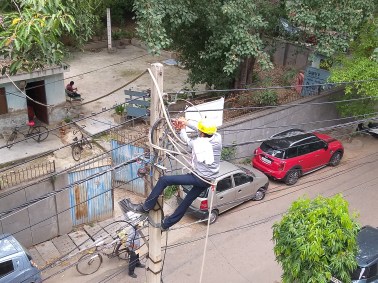
I was struck by surprise when I spotted, right in front of me, a man who was hanging from the electricity pole like a monkey from a tree. His worker protection is quickly described: a bright yellow helmet, bulky shoes, and a rope around his waist that tied him to the pole. And, of course, he was wearing a face mask. We are, after all, in the middle of a pandemic. Whether there is any risk of infecting someone else high up on an electricity pole is something I have some reason to doubt. It simply doesn’t strike me as the kind of place populated by crowds all day, I think. But a rule is a rule.
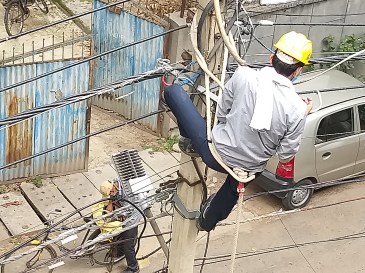
Oh, I almost forgot to mention one important protective measure: the worker’s colleague, who was standing down on the street and looking up at his colleague, focused, brows furrowed critically. Soon, I was targeted by that critical look as well, once I pulled up my mobile phone to take some pictures. But I was not skeptical at all. In fact, I was really impressed by this man’s climbing expertise. And he disconnected the electricity supply of the neighbor’s house in a jiffy. He “protected” the power line endings with some colorful tape. And now, I wondered, what will happen now?
Sure thing, another pragmatic solution was called for. What was a single worker hanging from an electricity pole to do? His tape was already in his hand and so he simply taped the power line endings back to the main line. Whoosh and he was off the pole again. That’s how things are now: The disconnected power line is taped to the main line. But it is also still connected to the neighbor’s house and is hanging in a low-hanging arch across the street. I am quite curios how long this will be the case. (Incidentally, this entire event had no further effects on us, apart from the blackout, which was temporary as power kicked in right away once the work was done.)
Something that is quite noticeable at our home are the variations of electricity in our power lines. That is something that one does not really know in Germany or the US. Here, electricity flow is not constant. Because of that we have stabilizers which are attached to bigger and more important machines like our ACs.
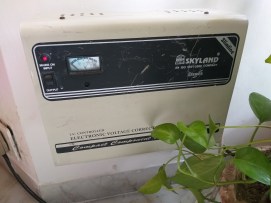
These are meant to support the work of the big machines. They also prevent these machines from breaking. Often these stabilizers are already built into the larger electrical devices – like fridges and so on – but not into all of them.
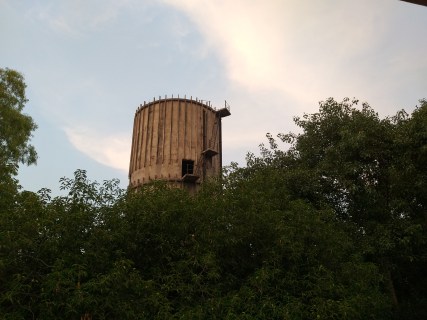
Now you may be asking yourself whether we notice these variations in electricity supply? And how? Yes, we do notice them. Close to our apartment, right across the street, there is a big water tower that provides our whole neighborhood with water. Once or twice a day water is pumped up into the tower. Such a pump needs a lot of electricity. When it starts to run, all our stabilizers kick in. That is noticeable by a clicking sound. Our lamps also always flicker a little bit. Sadly, these variations often prove fatal to our light bulbs. They just don’t survive that for a long time. This became almost a problem for us during the long lockdown period that India faced to slow down the Corona pandemic. One after the other of our bulbs died during that period.
Our living room, in which we have a lot of light spots in the ceiling, became more and more romantic (meaning: the light became dimmer and dimmer) and at one point almost completely dark. We were not able to get any new ones because they were not on the list of the essential things one could get during lockdown. Also, no electrician was able or allowed to come to our apartment and exchange the spots…lucky us (at least as far as the light situation is concerned) the lockdown was lifted before we were in complete darkness. Now, after the sun has set, we are again in full spotlight – at least until further notice! 😉
 Adventures in India - Sabrinas Indienblog