
Today I am writing for the first time about the topic that the whole world is currently talking about: Corona. Of course, in India this viral disease is a if not the main topic as well. Like most other countries in the world, India, too, is trying to deal with Corona or to control it even. However, in India, the conditions under which one can or needs to deal with it are very different from those in e.g. Germany or other countries in Europe, where the numbers are low. They are also completely different from those in the United States, for even though the numbers in India are high, and rising, India is still behind the U.S. when it comes to the total number of Corona cases (at least the official numbers) as of today, i.e. the day I am writing this post. (This might change quickly, though).
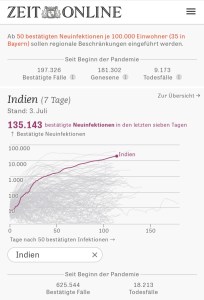
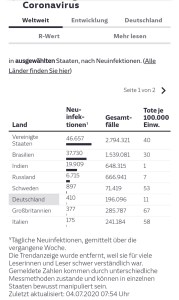
What makes the situation so different? First off: population count. India’s population count is estimated at 1.38 billion people. That number makes India second only to China, which currently has the largest population on the planet. According to some projections, India is expected to overtake China’s numbers in 2022 and is to take the lead in terms of being the country with the biggest population on earth. India hosts 17.7% of the world’s population, but takes just 2% of the land surface. The population percentage will even rise. What does that mean for the density of population? I took the numbers I found at https://www.worldometers.info/geography and calculated that on average, 4640.4 people live in one square kilometre [0.386102 square miles]. That said, one has to keep in mind that the population in India – as in other countries – is not distributed evenly across the country. In megacities like Delhi and Mumbai (and some others), many more people share the same space as people in the Northern states in the Himalaya area. I found data on Delhi from the year 2011 online. According to it, 11,320 people live in one square kilometre. The number is much bigger these days, I am rather sure.
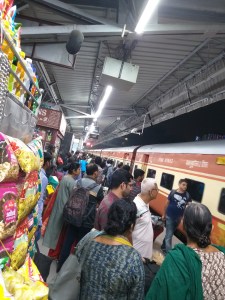
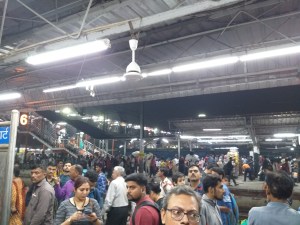
Now, this opening was a bit heavy on numbers. What do they mean concretely? Concretely, they mean that in the city, you run into people always and everywhere. That things are more packed everywhere. Everywhere there is scrambling, pushing, and shoving, and sometimes you just have to actively push forward or to the side (even if doing this is not really in your nature) in order to get your turn. Class segregation becomes correlated with crowdedness. While the well-located and well-off neighbourhoods provide bigger apartments, broader streets, parks and enough space to live and breathe, in other areas, people are squashed together. The latter provides ideal circumstances for the virus to spread and jump from one person to another.
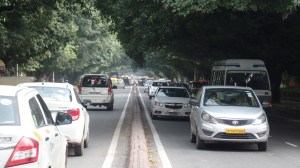
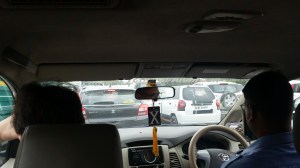
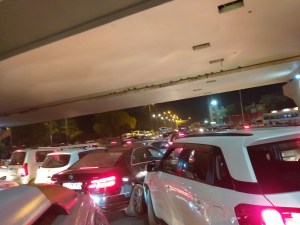
To slow down the spreading of the virus, the Indian government had enforced a radical measure: The government forced all people in India – all the 1.38 billion people – into a full lockdown, which was announced and implemented over night on the 24th of March this year (2020). That meant that nation-wide, all people were locked in at home (if they had one).
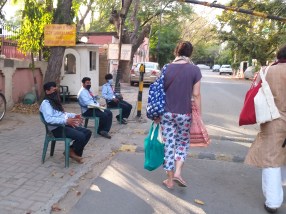
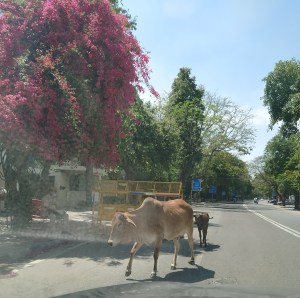
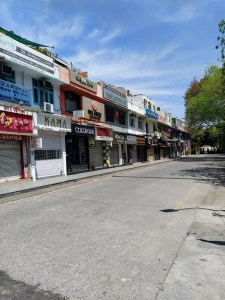
We were only allowed to walk to the closest store to fetch some groceries. We were also able to get to the pharmacy or to see a doctor in an emergency. But anything else: not allowed. Even a little stroll in the neighbourhood was almost impossible, unless you could plausibly claim that you were on your way to the milk stall, say. For some people, these rules were not too easy to understand (or abide by), so without further ado, our neighbourhood welfare society resorted to locking all the entrances to the parks with massive iron chains. Overnight, a jammed city turned almost into a ghost city. It was so quiet. Unbelievably quiet! Gone was the by now familiar noise of honking cars, no airplane was in the sky, no aircraft noise could be heard, no scooter or motorbike clattered by, no construction site would produce the hammering sounds of construction workers at work. It was so unusual. Quickly, the air quality improved significantly and we were able to listen to cheerful bird songs in our neighbourhood. In a way, Delhi had turned into a ghost city just in the modern sense of what a lively city should be like. But in a different sense, our environment was as lively as we had never been able to notice before. Incredible!
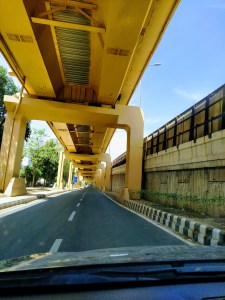
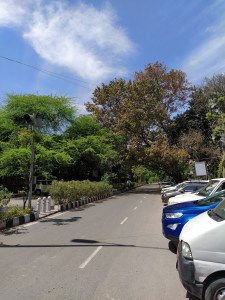
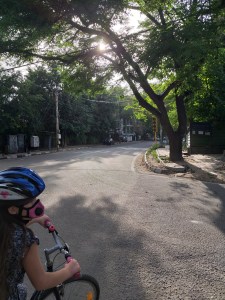
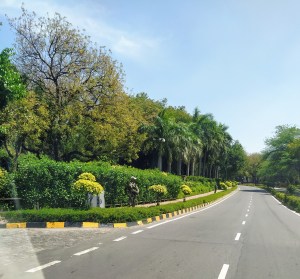
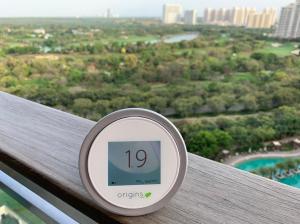
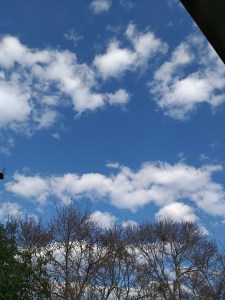
For us, this ad hoc lockdown brought silence and relief from the usual onslaught of urban noises. We were able to experience the wildlife around, enjoyed the good air quality and at least in part: having fewer obligations. This was the bright side of the coin. But there was also a very dark, sad, and tragic side. I will here just briefly mention the plight of the migrant workers, who destitute and unable to make a living, fled the big cities in flocks. This human tragedy is a complex topic, so I would like to write about it in a separate post.
Accordingly, back to the topic of social distancing and lockdown: Because of the high population density, you meet, even under lockdown circumstances, a lot of people e.g. while shopping at the little corner shop or the veggie store close by. How to cope with that situation and how to avoid that 10-20 people squeeze together in a small* corner store? Easy, you draw circles in front of the shop or on the sidewalk to mark the places in which you are to wait and which you have to take, one-by-one, as you proceed. One moves forward, circle by circle, until it is one’s turn to step into the shop. I love this pragmatic approach!
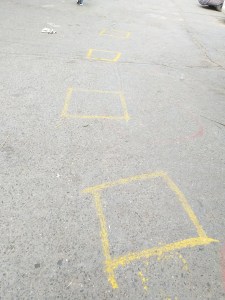
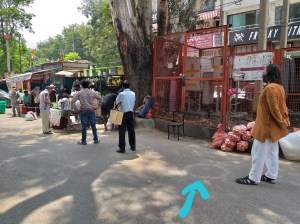
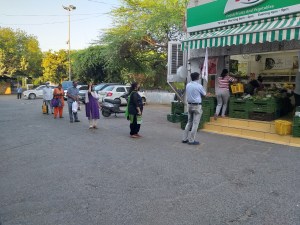
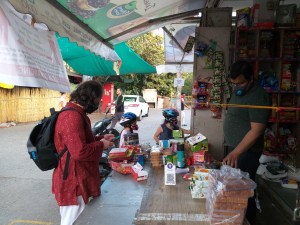
All people (at least everywhere we went) followed this technique and abided by the rules. I myself, with several experiences of having to fight through the crowed at a metro station with two small kids, could not have imagined something like this. I am not in a position to say whether people followed the rules because they were afraid of the disease or whether it was due to the police and the military personnel that one could see everywhere. Both options are conceivable.
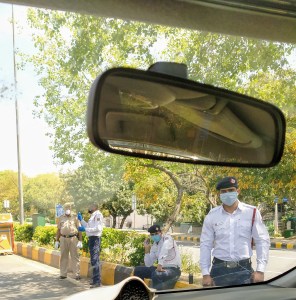
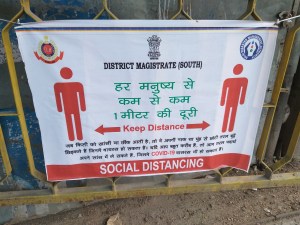
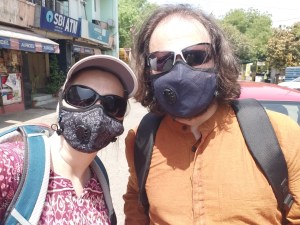
The mandate to wear a mask had been followed almost 100% in our radius in all social classes. Unfortunately, we notice now, after the lockdown has been lifted after 12 weeks, that more and more people are getting lazy and start to be lax about safety arrangements such as keeping distance or wearing masks. Of course it is extremely uncomfortable to wear a mask when the daily heat goes up to 40 degrees centigrade (104 F) – it seems almost impossible to work in such conditions. Sweat is accumulating underneath the mask, breathing becomes difficult. More and more people do not wear their masks correctly. They wear them under the nose, under the chin even. For me, the most irritating people are those who wear the mask gallantly around the wrist. Who or what is supposed to be protected like that? The bad habit of not wearing masks creeps in across social strata. The street sweeper, the lady who carries the bricks at a construction side, the runner wearing expensive running gear, and the walker carrying a Rolex around his wrist. It is a big problem, especially now with rising numbers of Corona cases and a health care system that is unable to cope with the potential needs of such a big population.
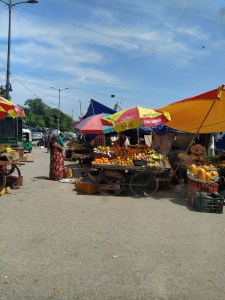
I do not want to end on such a sad note. There are still many people who take the safety arrangements seriously, wear their masks, and keep their distance. Concerns about the virus are ubiquitous. I hope India will prove to be able to keep the disease in check for as long as possible. That is my wish for this fascinating country and all the people who live here.
*[For all who have never been to India: When I say small corner store, I mean it. Imagine a small garage, an European double garage at max – not bigger.]
Thank you, I., I. and R., for supporting that post with your images. ❤
 Adventures in India - Sabrinas Indienblog